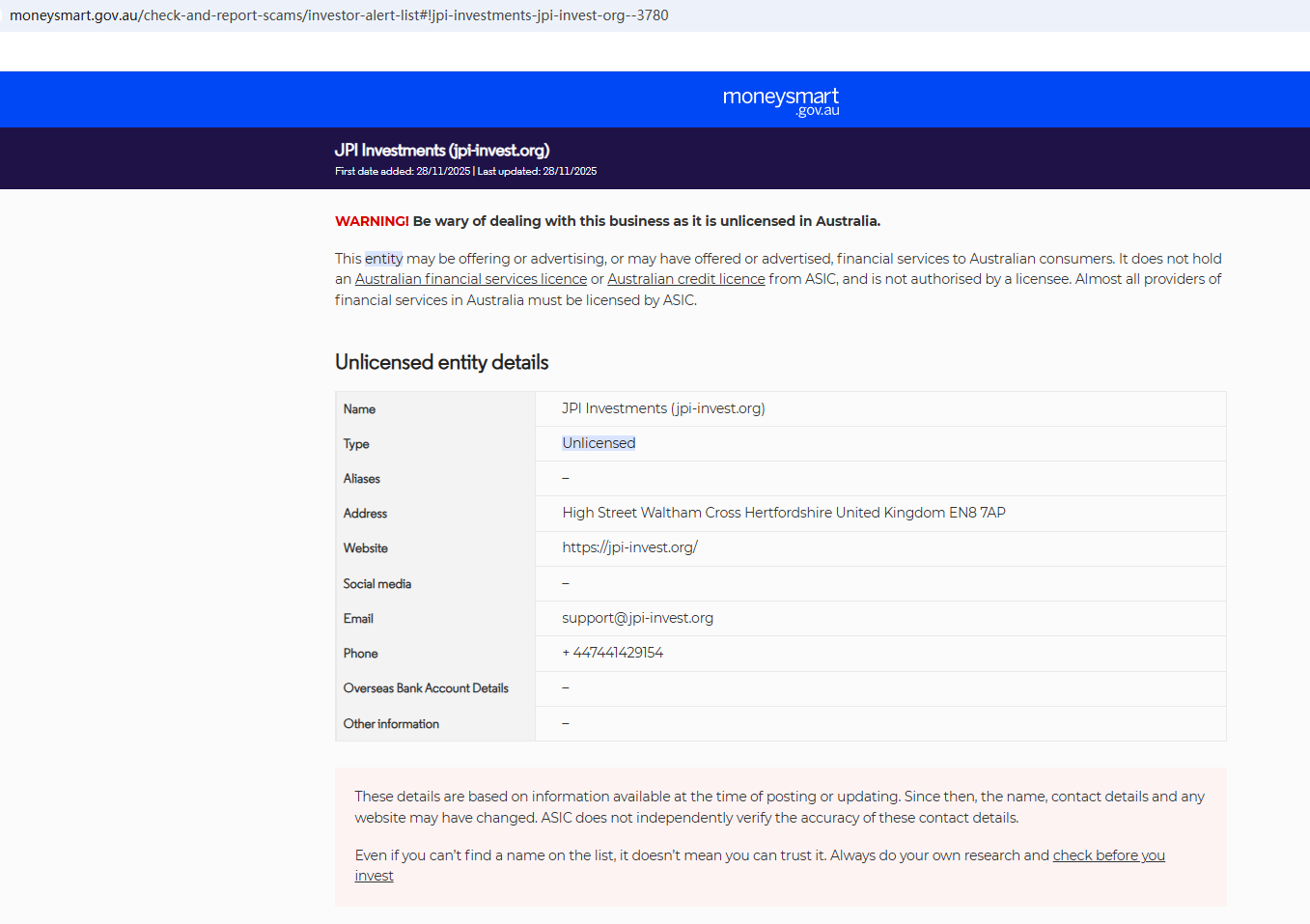
JPI Investment (also referred to online as JPI Investments or jpi-invest.org) is a website that presents itself as a modern cryptocurrency and forex trading broker with “cutting-edge” tools and impressive returns. This article is written to instruct readers and make crystal-clear that the safest course today is to avoid JPI Investment until verifiable proof of regulation, corporate identity, and audited operations appear. Below you’ll find the key red flags, the ways the scheme typically targets victims, immediate steps to limit harm, and how to pursue recovery if you’ve already been affected.
What JPI Claims — and Why Those Claims Don’t Add Up
On the surface JPI Investment markets familiar promises: fast account onboarding, high-yield strategies, expert account managers, and “secure” withdrawal systems. The marketing copy often includes social-proof screenshots, glowing testimonials, and claims of long operational history. But several concrete contradictions undermine those claims:
- The website’s stated founding date and the domain registration dates do not match, a classic sign of fabricated legitimacy.
- There is no verifiable registration with established financial regulators, meaning no consumer protections or oversight.
- Testimonials and reviews appear to be produced internally rather than by independent third parties.
Because of these inconsistencies, security watchdogs and several online reputation services mark the platform as suspicious and warn potential users to stay away.
How the Typical JPI Investment Scam Operates
Scam operations that resemble JPI Investment commonly use a predictable set of social engineering techniques:
- Attractive promises of guaranteed or unusually high returns, designed to overcome rational skepticism. This is one of the oldest tricks in financial fraud.
- High-pressure outreach via email, chat, or phone, urging deposits now to lock in “exclusive” rates. A natural reaction to urgency is to act before investigating.
- Fake performance dashboards or manipulated account balances that show growth — until users attempt withdrawal.
- Requests for additional “security” or “tax” payments when users attempt to withdraw funds.
If you receive any of these signals from JPI, treat them as immediate red flags.
Recognize the Red Flags: Don’t Fall for These Signs
- Lack of licensing or regulatory registration. Reputable brokers list their licenses and make them easy to verify.
- Domain age and WHOIS privacy. New domains and hidden ownership are common among scam sites.
- Pressure to fund quickly via unusual payment rails (crypto wallets, private payment processors). Legitimate brokers offer regulated banking rails and transparent receipts.
- No independent, verifiable customer reviews. If all praise comes only from within the site, it’s suspect.
If you spot these, stop engagement and do not transfer funds or ID documents.
Immediate Actions if You’re Considering JPI Investment
- Pause. Do not deposit money, upload ID documents, or install any remote-access software at their request.
- Search official regulator registries before anything else — for example, use the FCA (UK), ASIC (Australia), CySEC (Cyprus), or your local regulator to verify licensing. If you can’t find them, that’s a major red flag.
- Keep written records of communications (emails, chats, screenshots). These will help if recovery or reporting becomes necessary.
- Report suspicious contact to local authorities and your bank. If a bank or payment processor was used, file a fraud report immediately.
If You Already Deposited Funds: Steps Toward Recovery
- Immediately notify your bank or payment provider. Ask them to freeze or reverse transfers if possible.
- If you paid by card, file a chargeback with your card issuer and provide evidence of fraud.
- If you used an online payment processor, open a fraud dispute and follow their instructions.
- If the platform asked for ID and you shared it, consider identity-protection steps (notify credit bureaus, file an identity-theft report).
For victims of crypto scams, the recovery path is harder, but time-sensitive actions still help: contact the exchange or wallet provider used for the transaction and request a freeze, and report the incident to cybercrime authorities. Remember that success rates vary widely, and early action is critical.
How Scams Like This Use Psychological Levers — And How to Resist Them
Fraudsters exploit cognitive biases: urgency creates panic, social proof generates false credibility, and complex financial jargon hides the lack of real process. The antidote is simple: slow down and verify. Legitimate financial businesses welcome due diligence; if a platform resists transparency or discourages independent checks, walk away.
Four Keywords You Should Watch For
- Crypto Scam — any platform promising guaranteed crypto yields without regulation should be treated as a probable scam.
- Forex Scam — the same rules apply in FX: unlicensed platforms or unknown brokers are very high risk.
- Crypto Reclaim — services promising guaranteed “crypto reclaim” or recovery for an upfront fee are often a secondary scam. Be skeptical.
- Recovery — genuine recovery services will not demand large upfront payments and will provide verifiable track records.
If Someone Offers “Crypto Reclaim” or Recovery Services
A common follow-on scam preys on victims: individuals who lost money to JPI Investment are offered a fast “recovery” service — for a new up-front fee. These recovery schemes are usually fraudulent. Legitimate recovery professionals work through legal channels and rarely ask for large upfront fees. If you are approached by a recovery service, ask for verifiable references, request a written contract, and consult legal counsel.
Legal Routes and Reporting Channels
- Report fraud to your local law enforcement. Many countries have cybercrime or financial-fraud hotlines.
- File complaints with your financial regulator and consumer protection agencies. They may not always recover funds but can warn others and collaborate with international partners.
- Use public platforms to warn others: post factual, evidence-based reports to consumer forums and review sites so other people are better informed. (Search and share findings on major search platforms and community boards.)
RECLAIM NOW — immediate action matters. RECLAIM NOW
External resources to research a company include search engines and community feedback sites. If you want to dig deeper, search using major engines and community forums for user reports and domain history. For a quick verification, try searching on some large platforms (use a broad search on Google), and check community boards like Reddit for independent discussions — but always evaluate the credibility of each poster.
A final operational tip: keep copies of all contracts, screenshots of your account at the moment you discover issues, and maintain a written timeline. These things make legal actions and recovery attempts much stronger.
RECLAIM NOW — if you have been targeted, consider swift reporting and dispute steps. RECLAIM NOW
Remember: legitimate financial service providers expect scrutiny and never push you to deposit immediately without providing verifiable legal details and third-party audits. If JPI Investment continues to refuse transparency, do not engage and do not deposit funds.
RECLAIM NOW — check official registries and request proof of license before considering any interactions. RECLAIM NOW
If you need direct help collecting evidence or drafting formal complaint letters to banks, regulators, or law enforcement, I can create those documents for you step-by-step.
RECLAIM NOW — act now to limit further exposure. RECLAIM NOW