In a digital era where crypto-trading platforms spring up daily, it has become ever more important to distinguish legitimate providers from likely scams. On its website, NiagaraHub markets itself as a “crypto trading platform” with history and institutional-style infrastructure. But independent reviews, trust-scans, and broker-watcher alerts raise multiple red flags — enough to treat NiagaraHub as high-risk.
If you’re thinking of depositing funds or have already done so — read this carefully. If you believe you’ve lost money already, begin evidence collection and get a professional evaluation: RECLAIM NOW.
What NiagaraHub Claims — And Why It Seems Attractive
On the public homepage, NiagaraHub presents itself as a Canada-first crypto-trading platform, offering “institutional-grade infrastructure,” “secure custody workflows,” “transparent pricing,” and a “10+ year track record.” (niagara-hub.net)
It promises a user experience combining ease for beginners and tools for advanced traders — order types, portfolio analytics, and crypto-asset trading. According to their marketing, they’re built for “everyday investors and professionals alike.” (niagara-hub.net)
For someone unfamiliar with due diligence, the site’s polish — neat UI, professional-sounding language, and grand claims — can seem convincing. But good marketing rarely equals legitimacy.
Independent Safety & Reputation Checks — Strong Warning Signals
🛑 Extremely Low Trust Scores & Blacklist Flags
A scan by a widely used site-safety analysis tool gave niagarahub.net a 1/100 trust score, classifying it as a “Suspicious Website.” (gridinsoft.com)
The scan highlights major risk factors: very recent or fresh domain registration, hidden ownership (WHOIS privacy), limited traffic, and hosting or server patterns associated with suspicious websites. (gridinsoft.com)
This kind of low score from automated safety tools is a strong indicator — not a guarantee — that the site may be unsafe or used to perpetrate scams.
⚠️ Broker-Watcher & Scam-Review Alerts
A recent analysis on a broker-review site flagged NiagaraHub under “Doubtful Website Conduct.” The review calls out unclear ownership, suspicious contact info, and poor-quality content — traits commonly seen in fraudulent platforms. (brokersreviewer.com)
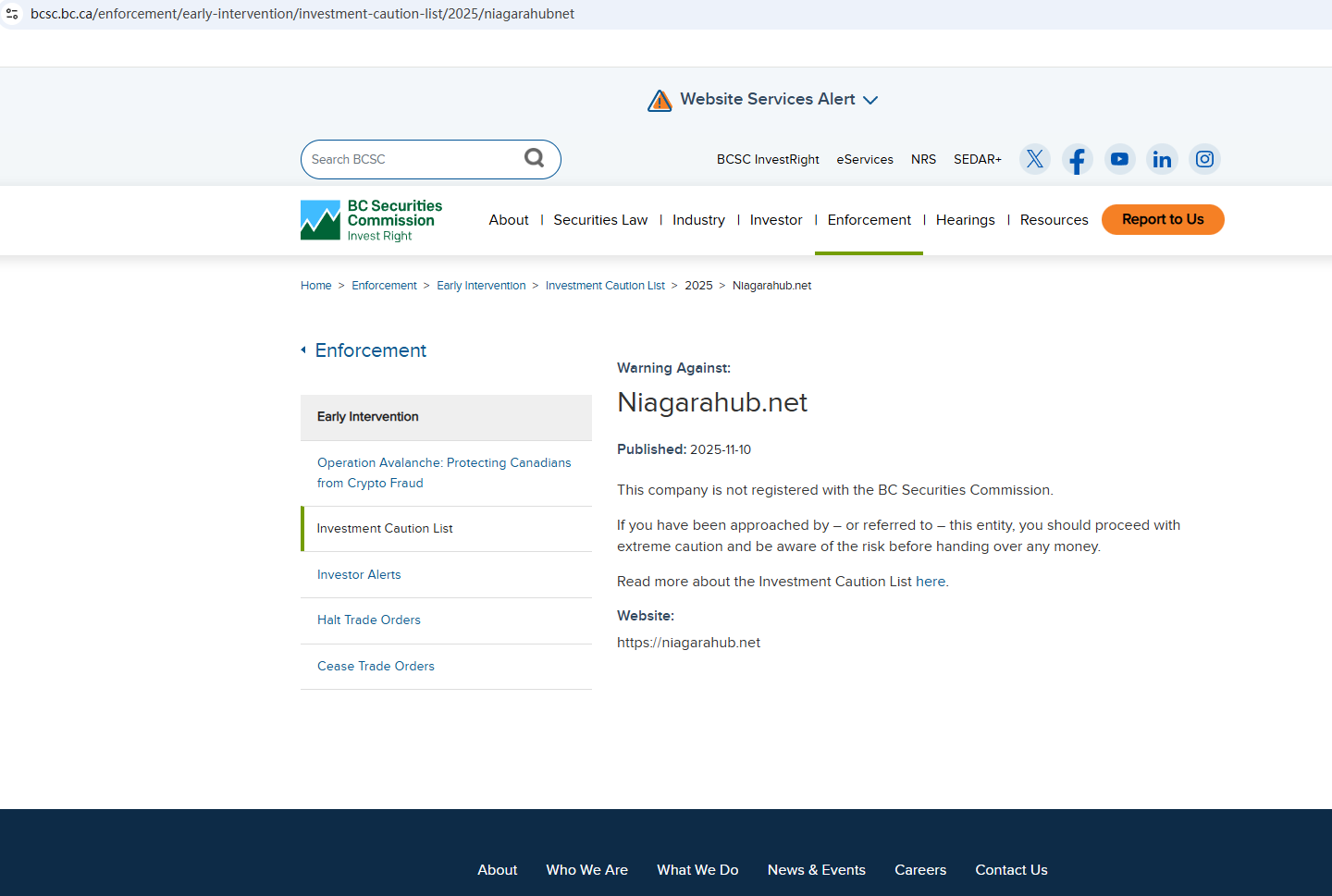
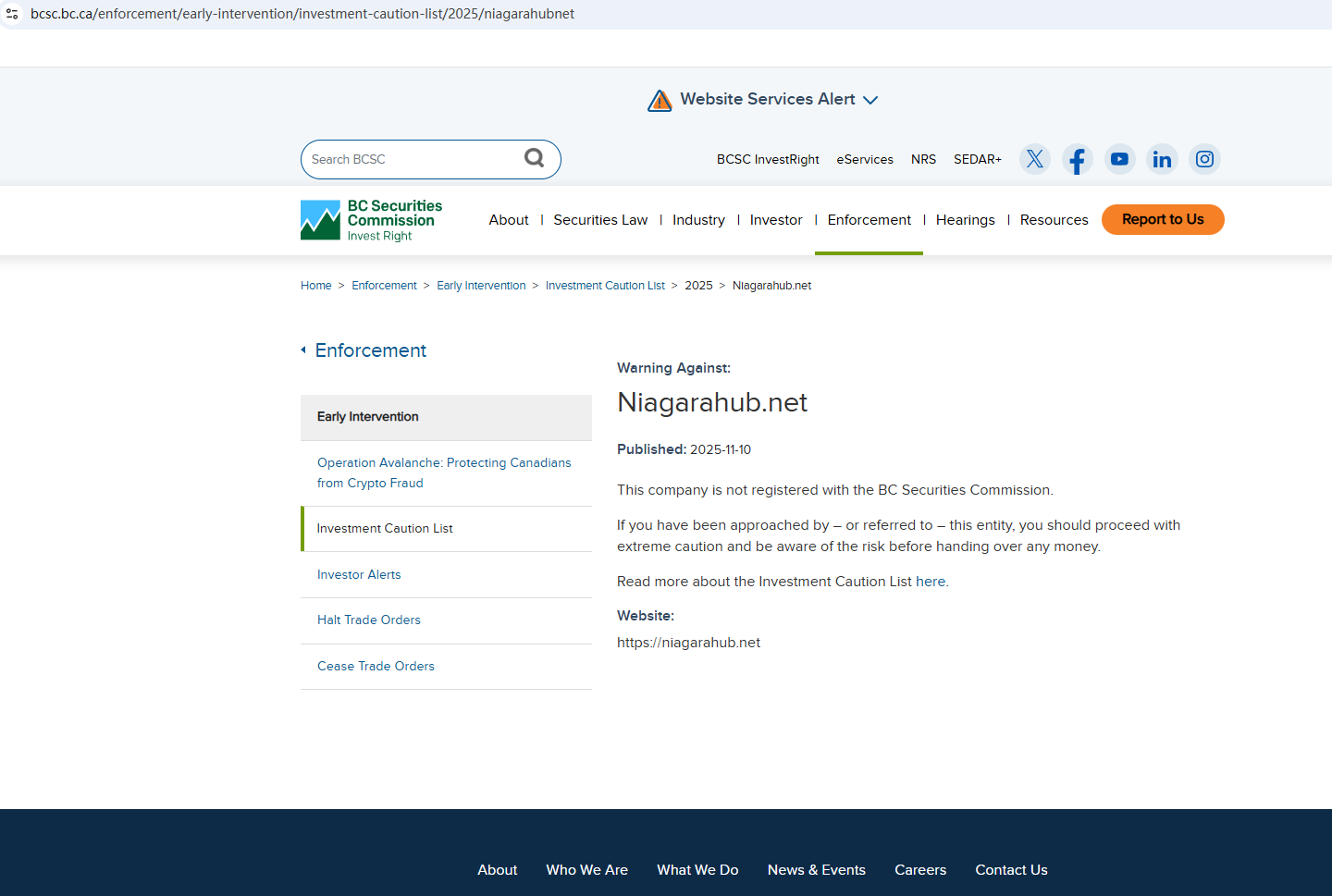
Another watchdog article states that NiagaraHub lacks registration with any well-known or respected financial authority, which means it is unregulated — a massive red flag for a crypto-broker. (thesafetyreviewer.com)
Because regulation provides oversight, accountability, and (in some jurisdictions) consumer protections — lack thereof means there is virtually no guarantee that your funds are safe, or that you’ll be able to retrieve them if something goes wrong. (primexbt.com)
Why These Issues Matter — Risks You Face
If you deposit money with NiagaraHub, you risk:
-
Loss of funds. Without regulation, there is no guarantee that deposited assets are held safely, nor that withdrawals will be honored.
-
No accountability or recourse. In the event of fraud, mismanagement, or platform collapse, you may have no legal or regulatory body to appeal to.
-
Potential data / identity risk. Hidden ownership and anonymity of operators increase the risk of misuse of personal or payment data.
-
Misleading returns & unrealistic promises. Many scam brokers promise high returns or “institutional-grade security,” but those claims rarely hold up under scrutiny. No legitimate broker guarantees profits. (coinrule.com)
Combined, these factors place NiagaraHub firmly on the “high-risk / likely scam” side of the spectrum.
WARNING PATTERNS — How NiagaraHub Matches Known Scam Broker Behavior
Legitimate brokers and exchanges typically share certain characteristics: verifiable regulation, transparent corporate/ownership info, public license numbers, established history, and consistent third-party reviews. Fraudulent or suspicious ones — like NiagaraHub — often lack many or most of those traits. Experts highlight several “red-flag” patterns for crypto fraud: fake websites, anonymous teams, unrealistic guarantees and requests for crypto payments. (getsmarteraboutmoney.ca)
Here’s how NiagaraHub matches that profile:
-
Hidden ownership (WHOIS privacy) and low trust score from safety scanners. (gridinsoft.com)
-
Lack of registration with respected financial authorities — no license displayed or verifiable. (thesafetyreviewer.com)
-
Recent domain registration and minimal web footprint — few external references or credible independent reviews. (gridinsoft.com)
-
Marketing that emphasizes “simplicity,” “institutional-grade security,” and “high convenience,” hallmarks of scam-style persuasion. (niagara-hub.net)
When multiple red-flag factors accumulate, the likelihood of the platform being a scam increases significantly.
Regulatory & Industry Guidance — Why Experts Advise Caution
Authorities and consumer-protection guides consistently advise verifying a broker’s regulatory registration and license, confirming a physical address and verifiable contact information, and avoiding platforms with hidden ownership or offshore/unregulated status. (cftc.gov)
As noted by a widely cited fraud-prevention guide: “Fake websites, anonymous teams, unrealistic guarantees and requests for crypto payments are common in crypto-scam platforms.” (getsmarteraboutmoney.ca)
In short — the very structure and public footprint of NiagaraHub raise too many red flags to treat it as trustworthy.
FOUR KEYWORDS TO WATCH FOR
Whenever you’re assessing a platform like NiagaraHub — or investigating something you suspect may be suspicious — check whether these keywords appear in credible analyses or user reports:
-
Crypto Scam
-
Forex / Broker Scam
-
Crypto Reclaim
-
Recovery
If any of those terms appear in association with the platform — especially in independent forums or watchdog reviews — treat them as serious warnings.
WHAT TO DO IF YOU’RE CONSIDERING OR HAVE ALREADY ENGAGED
If you’re thinking of using NiagaraHub — or have already deposited funds — here’s a safety-first checklist:
-
Do not deposit any more funds unless you obtain verifiable proof of regulation (license number, registered address, public record) and confirm the operator’s legitimacy independently.
-
Test with a minimal amount first, and attempt an immediate withdrawal. If withdrawal fails, view that as a signal the platform may be compromised.
-
Document everything — payment receipts, transaction IDs, email / chat communication, screenshots of your dashboard. This will be essential evidence in any dispute or recovery attempt.
-
Use payment methods that allow chargebacks / disputes (e.g., bank card) rather than irreversible cryptocurrency transfers, if possible.
-
Seek community feedback / independent reviews — search for the platform name online; check forums, regulatory warning lists, review sites. Use Google or community platforms like Reddit for broader context.
-
Treat “recovery” or “reclaim” services with caution — many are scams themselves. If you pursue recovery, only use reputable, independently verified firms, and treat any upfront “fees” with suspicion.
If you already suspect funds are lost, start building evidence and get an evaluation from a vetted recovery professional: RECLAIM NOW.
NiagaraHub — as presented on its website — aims to appear as a legitimate, user-friendly crypto trading platform with “institutional-grade infrastructure” and a long track record. On paper, that might appeal to many looking to enter crypto or diversify investments. But when you peel back the layers, the public evidence paints a far more troubling picture.
Automated safety scanners give NiagaraHub a very low trust score (1/100), citing hidden ownership, minimal domain history, and suspicious server infrastructure. Independent broker-watchers and scam-review sites label it as “doubtful,” unregulated, and lacking the transparency expected of real exchanges or brokers. Regulatory-compliance checks — a cornerstone of legitimate financial services — return no verifiable license or firm registration, meaning client funds are likely unprotected.
When a platform lacks verifiable regulation, hides its owners, has little third-party footprint, and relies on slick marketing and promises of convenience — at best it’s extremely high-risk; at worst, it might be a scam designed to steal deposits. In the world of crypto and online trading, that distinction matters deeply.
If you haven’t deposited anything: treat NiagaraHub as high-risk and avoid further engagement. If you already did: act quickly — gather all your records, stop further deposits, avoid additional risk, and consider contacting your bank/payment provider (if relevant) to dispute transactions. If you used crypto, hold onto all transaction IDs and wallet info; but be aware recovery will be much harder, and success is uncertain.
Finally — share this with others, warn friends and family, especially those new to crypto. Platforms like NiagaraHub exploit trust, hope, and lack of regulation. Real, legitimate investing may not promise instant profits or flashy returns — but it’s backed by transparency, documented oversight, and respect for investor protections.
If you need help collecting evidence or want a ready-to-send complaint template for your bank or regulator, I can draft that for you and include the exact wording and evidence checklist. Start your recovery evaluation here: RECLAIM NOW