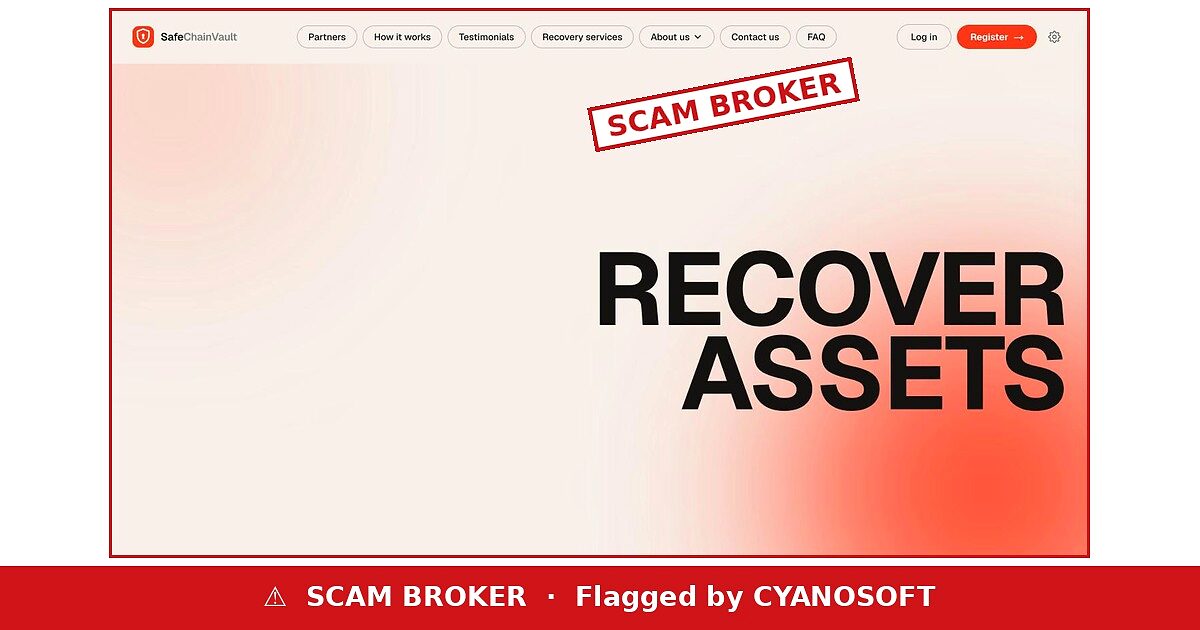
Verdict up front: SafeChainVault (safechainvault.org) sells “Recover Assets” services to people who have already lost money to crypto, forex and romance scams. The UK’s Financial Conduct Authority has warned about it. FCA (UK) warned about it (published on IOSCO I-SCAN on 5 October 2026). The domain was registered on 5 August 2026 — about 2 months ago.
| Website | safechainvault.org |
|---|---|
| Name used | SafeChainVault |
| Service | Recovery of lost crypto, forex and romance-scam funds |
| Claim | Chases funds “across 100+ chains” and works with banks, exchanges and authorities |
| Warning | FCA (UK), I-SCAN 5 October 2026 |
| Listed | FCA (UK) warning, published on IOSCO I-SCAN 5 October 2026 |
| Domain registered | 5 August 2026 — about 2 months old |
The second scam
Recovery scams target people who have already been defrauded. The victim is promised that lost money can be traced and returned — for a fee paid first. The fee is the scam. The original money never comes back.
Contacted by someone from SafeChainVault?
✎ FILE A COMPLAINT ABOUT SAFECHAINVAULT
Include the website, what you paid and any screenshots. Never send passwords or seed phrases.
Promises no one can keep
The site says it can chase funds “across 100+ chains” and “coordinate with banks, exchanges and authorities”. Private firms cannot order exchanges to freeze or return funds. Only courts and law enforcement can.
Two months old
The domain was registered on 5 August 2026. The menu shows Partners, Testimonials and “Recovery services”, but there is no company, address or licence.
What the FCA warning means
The FCA warns about firms that may be offering financial services without authorisation. It is a warning, not a court ruling. It is also exactly what you would check before trusting a firm with your last savings.
⚠ Verified evidence
- FCA (UK) warning, I-SCAN 5 October 2026.
- FCA warning; site offers paid fund recovery.
- Domain registered 5 August 2026.
- Domain registered 5 August 2026.
How to check
Search the firm’s exact name and web address on the register of the regulator in your own country, and on IOSCO’s I-SCAN list. A real broker shows a licence number you can look up in under a minute — and the regulator’s own register links back to the broker’s real website.
What to do if you paid SafeChainVault
- Stop sending money — no “tax”, “release fee” or “upgrade” will unlock a withdrawal.
- Keep every record: receipts, wallet addresses, emails and chat screenshots.
- Call your bank or card issuer today and ask about a chargeback or recall.
- Report it to the regulator that issued the warning and to your local police.
- Ignore anyone who offers to recover the money for an upfront fee.
The verdict: SafeChainVault targets people who have already lost money. Pay no recovery fee.
Tell us what happened with SafeChainVault
✎ FILE A COMPLAINT ABOUT SAFECHAINVAULT
Include the website, what you paid and any screenshots. Never send passwords or seed phrases.
Sources, checked 5 October 2026: FCA (UK) warning via IOSCO I-SCAN (5 October 2026) · RDAP registration record for safechainvault.org · the live page at safechainvault.org, read in full. A regulator warning is not a court ruling. Educational content — not financial advice.
Rechecked on 17 November 2026
By 17 November 2026 safechainvault.org no longer loaded. The domain safechainvault.org was registered on 5 August 2026, and its registration record last changed on 15 October 2026.
How to check a warning from the FCA
Search the firm’s exact name and web address on the FCA Financial Services Register and on the FCA warning list. An authorised firm has a firm reference number, and the register shows its approved websites and phone numbers. If the site is not on the register, or its details do not match, you are not dealing with an authorised firm, and you will not be covered by the Financial Ombudsman Service or the FSCS. The FCA’s ScamSmart pages explain the common warning signs. Report the site to the FCA and to Report Fraud.
When a platform disappears, its dashboard, balances and statements go with it. Anyone who deposited should gather their own records now: bank and card statements, crypto transaction hashes, emails, chat messages and the names and numbers of anyone who called. Those records are what a bank, the police or a regulator will ask for first.
If you already paid
- Stop all further payments, including any “fee”, “tax” or “release charge”.
- Write down every wallet address you sent crypto to and the transaction hash for each transfer.
- If you bought the crypto through an exchange, report the transfers to that exchange’s support and fraud team.
- Report card and bank payments that funded the purchases to your bank as fraud.
- Report the site to the regulator named above and to the police.
- Be wary of anyone who contacts you offering to recover the funds for an upfront fee.