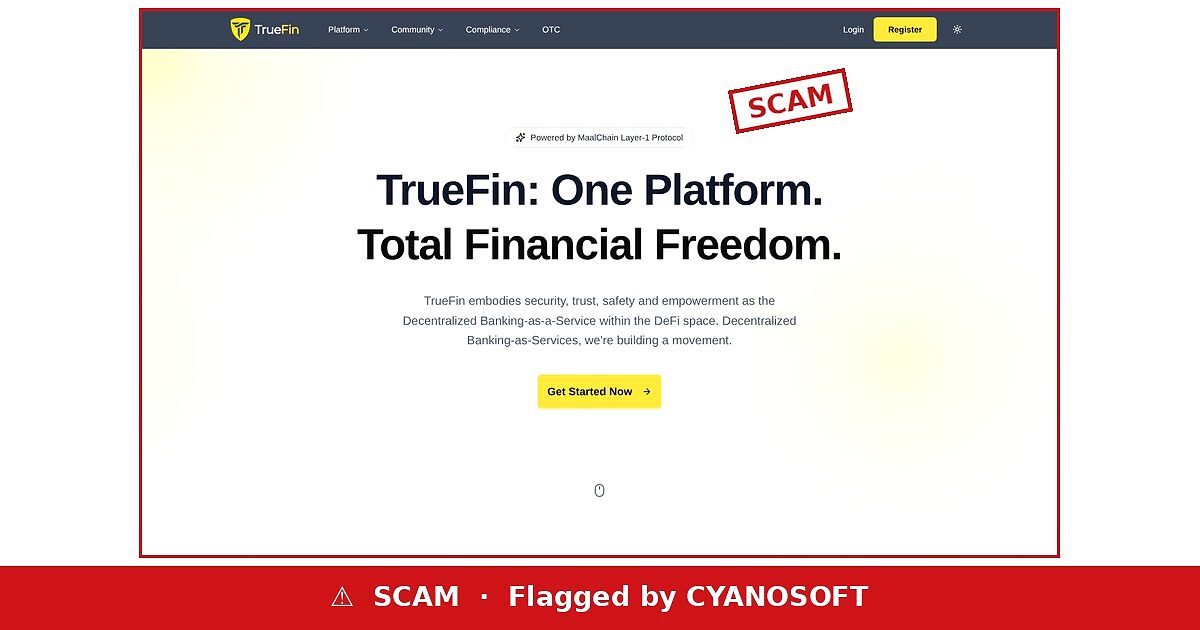
Checked 17 November 2026. Screenshot taken that day.
Securities Commission alert
TrueFin, named as TrueFin / TrueFin Digital Ltd, markets truefin.finance as “Decentralized Banking-as-a-Service” powered by the MaalChain Layer-1 protocol. A Securities Commission alert on the firm is dated 16 November 2026 on IOSCO’s I-SCAN database.
Technical profile
| Domain | truefin.finance |
| Registered | 18 May 2026 (RDAP) |
| Entry | “Platform access fee of $1000 worth of MAAL” |
| Promised return | “~5,000 MAAL over 5 years representing 50% ROI” |
| Referral rewards | “Up to 300,000 MAAL through community expansion” |
| Company in footer | GC Global Finance Ltd |
| Alert | 16 November 2026 |
Pay to join, earn by recruiting
Members pay $1,000 in the platform’s own coin, then “build your decentralized banking network” to earn referral rewards of up to 300,000 MAAL, with bonuses from 40,000 to 1 million MAAL at “network milestones”. Returns paid in a coin the platform controls, and rewards tied to recruiting, are the shape of a pyramid scheme. A “Licensing & Compliance” table claims multiple regulatory frameworks.
Before you pay a fee
Ask what the MAAL coin is worth if you try to sell it outside the platform. If the only buyer is the platform, the return is not real. Keep receipts and wallet records, and report payments to your bank.
How to check a the regulator warning yourself
Check the firm’s exact name on the securities regulator’s public register and investor alert list before paying anything. Ask what a platform coin is worth outside the platform. If the only buyer is the platform itself, any “return” exists only on screen. Schemes that pay members for recruiting new members tend to collapse once recruitment slows, and late joiners lose most. Report the scheme to the regulator and your bank.
How these schemes usually play out
Sites like this usually follow the same steps. First comes an advert, a social media message or a phone call. Then a small first deposit, often a few hundred dollars or euros. A dashboard soon shows fast profits, and an “account manager” pushes for a bigger deposit. When you try to withdraw, new fees appear: tax, insurance, verification or “unlocking” charges. Paying them never releases the money. At that stage, stop paying, keep every record, and report what happened.
Keep screenshots of the dashboard and your balance, the website address, every email and chat, phone numbers that called you, and every bank, card or crypto payment with dates and amounts. For crypto, keep the wallet addresses and transaction hashes. These records are what your bank, the police and the regulator will ask for first.
Sources: Securities Commission alert on TrueFin / TrueFin Digital Ltd (truefin.finance), 16 November 2026, via IOSCO I-SCAN (iosco.org). RDAP lookup. Site captured 17 November 2026.