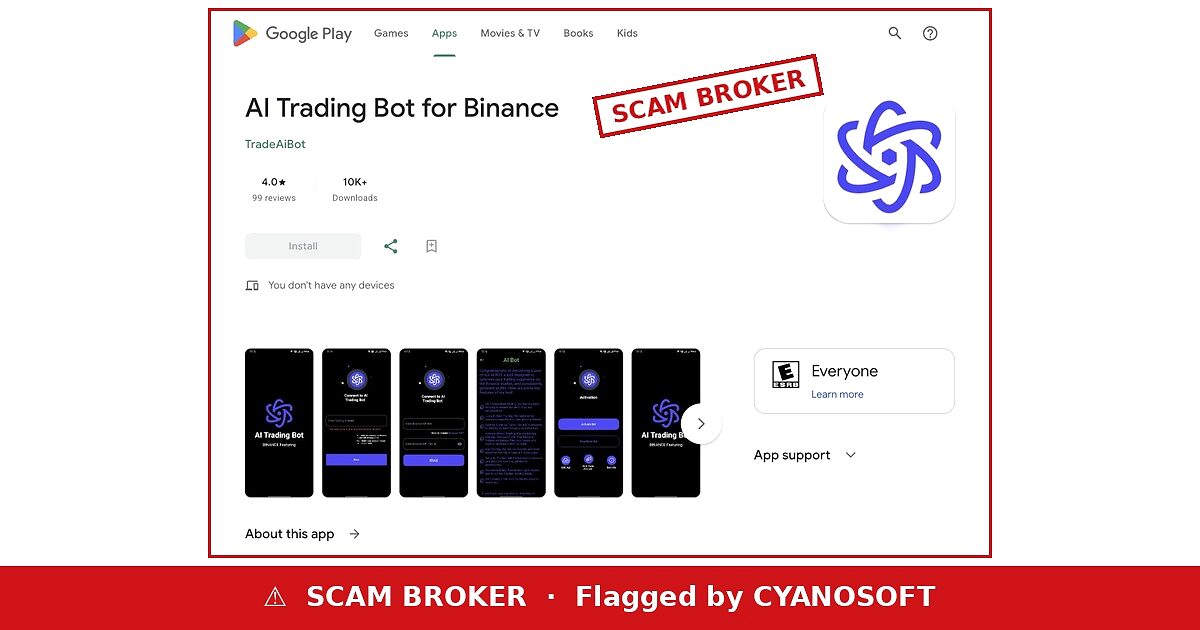
Verdict up front: this app is called AI Trading Bot for Binance. Its Android package identifier is com.binance.app. It is not published by Binance — the developer is a company called TradeAiBot. It asks you to hand over your exchange API keys, and its data declaration says it collects nothing.
AI Trading Bot for Binance is published by TradeAiBot. On the day we checked it showed 4.0 stars from 99 reviews and 10,000+ downloads, filed under Finance, last updated 1 June 2025.
The package identifier is the finding
Every Android app carries a package identifier, set when it is first published and never changeable afterwards. It is the app’s permanent address, and the com.binance.* namespace reads as Binance’s own — the exchange’s US arm publishes at com.binance.us.
This app occupies com.binance.app — the most natural-looking address in that namespace — while the developer field reads TradeAiBot.
Anyone checking the URL of this listing sees id=com.binance.app and reads it as official. That is the single most valuable thing the developer owns, and no amount of small print changes what it looks like in a browser bar.
What an API key actually gives away
From the store listing
“Connect your API keys on exchange, and start to use the AI BOT instantly… AI Trading Bot will never touch your funds instead it only uses official exchange APIs to conduct trading.”
The reassurance is narrowly true and widely misleading. A trading API key does not permit withdrawals. It permits trading — opening and closing positions in your account, with your money, at any size and frequency the holder chooses.
On Binance Futures, which is what this bot is for, that is leverage. An account can be emptied by trading alone, without a single withdrawal, and the listing’s promise remains technically accurate throughout.
“No data collected”
The Data safety panel declares no data collected and no data shared with third parties.
An app that receives exchange API keys has received the most sensitive credential a trader holds. If it truly collected nothing, it could not place a trade. That declaration cannot be reconciled with the product on the same page.
Where the money actually comes from
The description ends with an invitation:
“If you don’t have a Binance Futures account, then you can create one through here —
binance.com/en/activity/referral-entry/CPA?ref=CPA_00JR1YEBAY”
That is an affiliate referral link. The operator is paid a share of the trading fees generated by everyone who signs up through it — a commission earned on volume, not on profit.
Hold that next to what the bot does: it trades automatically, 24 hours a day, with scalping as an advertised feature. A scalping bot generates enormous fee volume whether or not the account makes money. The revenue model and the user’s interests point in different directions, and only one of them is disclosed.
Consistent profit, and a slip in the copy
The listing promises an algorithm that works “automatically to produce consistent profit”, is “perfectly built to produce daily profit”, and will “grow it consistently” from as little as $10.
Then, describing the minimum equity for this Binance bot, the text says: “You can simply start with $50 to $100 in your Bybit account.”
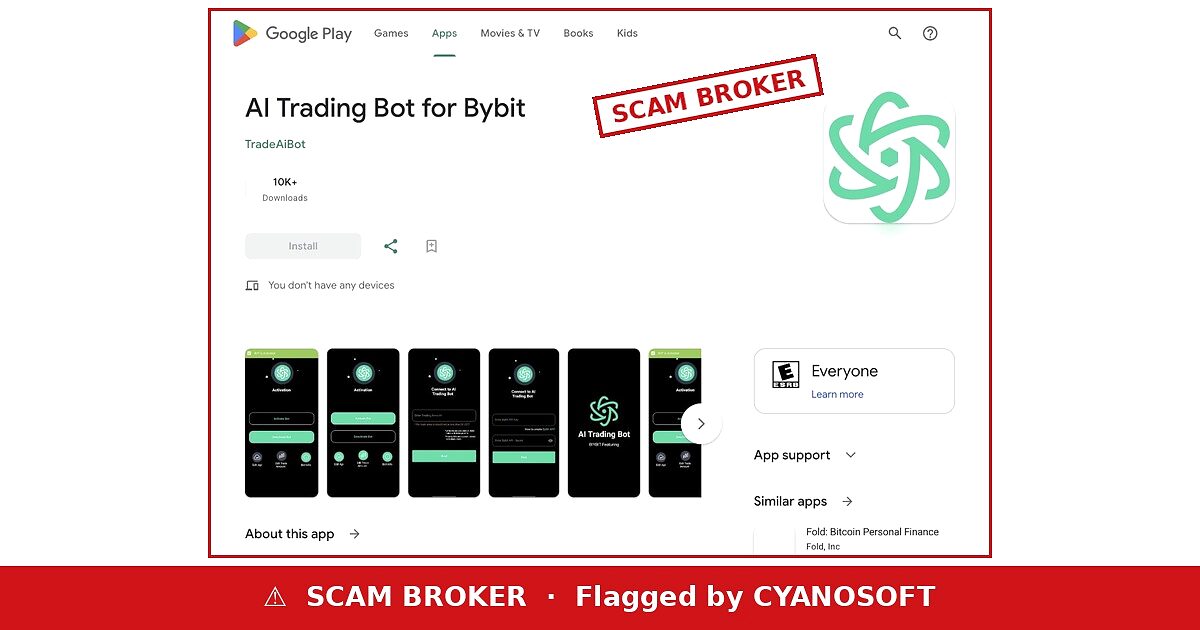
Bybit is a different exchange. The same developer publishes a near-identical AI Trading Bot for Bybit, and the two descriptions are the same document with one word swapped. On this listing the swap was missed.
Support runs through Telegram. The three reviews displayed are all from 2023 and read like product copy.
⚠ Verified evidence — checked 20 September 2026
Package com.binance.app, publisher TradeAiBot, not Binance · 10,000+ installs, 4.0 from 99 reviews · requests exchange API keys · Data safety declares no data collected and none shared · carries a Binance affiliate referral link · promises consistent and daily profit · refers to a Bybit account inside the Binance listing · support via Telegram.
We have seen borrowed identity do this work before, in a fake Pepperstone, and a payout ceiling that recedes in Bitcoin Cloud Mining.
What to check before you connect anything
- Read the package identifier in the Play URL. It is the one field no rebrand can alter, and here it names a company that did not publish the app.
- Never create an API key with trading permission for an app you cannot identify. On an exchange, restrict keys to read-only, bind them to an IP address, and delete any you are not using today.
- Treat “we never touch your funds” as a technicality. Trading permission is enough to lose the account.
- Look for the referral link. It tells you what the operator is actually paid for.