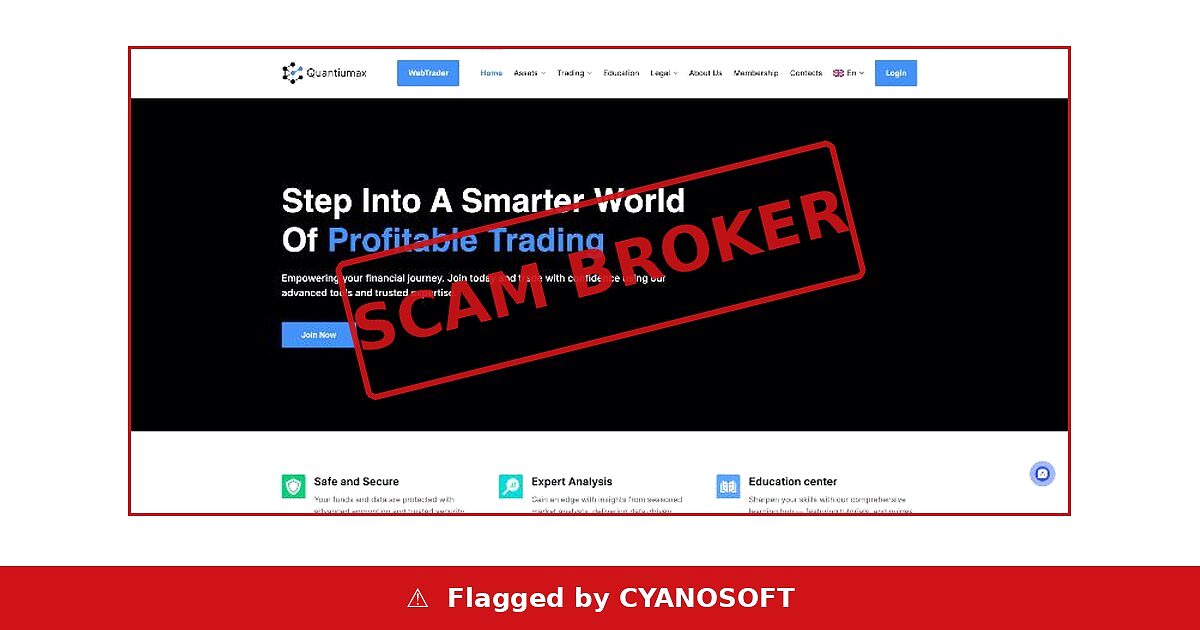
Quantiumax is a trading platform at quantiumax.one that CONSOB has named as an unauthorised operator in Italy. The site was live and polished when we reviewed it, promising smarter and profitable trading, which makes the regulator warning urgent for anyone being approached.
The CONSOB warning
On 5 November 2026 CONSOB listed Quantiumax among operators offering financial services to the Italian public without authorisation, and ordered access to the site blocked. A slick website and promises of profitable trading do not equal a licence. Without authorisation there is no oversight of client funds and no protection if deposits disappear.
Live site and recent domain
The quantiumax.one domain was registered on 18 February 2026. When we checked it the platform was fully live with a trading dashboard, education section and membership tiers. A professional looking site built on a recent domain and then flagged by a regulator is a common pattern. The polish is designed to win trust before withdrawals are blocked.
If you have deposited
Do not add funds and do not pay any charge framed as needed to withdraw. Capture screenshots of the live site and your account now, before the ordered block removes access. Report the operator to CONSOB and your bank. Cyanosoft can help you preserve evidence and begin a structured recovery case.
⚠ Verified Warning Evidence
- Regulator: CONSOB (Italy) named it unauthorised on 5 November 2026
- Domain quantiumax.one registered 18 February 2026
- Site fully live with trading dashboard at time of review
- CONSOB ordered the site blocked, no valid EU licence
Sources
Rechecked on 17 November 2026
On 17 November 2026 quantiumax.one was still online, showing only “You need to enable JavaScript to run this app” to our automated check, a sign of a single-page web app that hides its content from search engines and review tools. The domain was registered on 18 February 2026 and changed on 19 April.
The “.one” ending is a generic extension anyone can buy. A trading platform that is invisible to search engines is usually reached through links sent by contacts, adverts or call centres.
A site that stays online after a regulator warning is still taking sign-ups. Regulators can warn the public and, in some countries, order internet providers to block a site, but they cannot always take it down. That is why searching a platform’s exact name and web address on the regulator’s own warning list, before you deposit, matters more than anything the site says about itself.
If you already paid
- Call your bank today, tell them you have paid a fraudulent investment site and ask them to try to recall the payment.
- If you paid by card, ask about a chargeback.
- Change any passwords you shared and remove any remote-access app the caller asked you to install.
- Do not send ID documents or selfies to anyone connected with the site.
- Report the site to the regulator named above and to the police.
- Be wary of anyone who contacts you offering to recover the funds for an upfront fee.
Quick checks before any deposit
Before sending money to any trading or investment platform, ask three questions. Which company will hold my money, and where is it registered? Which regulator supervises it, and what is the licence number? Does that regulator’s register list this exact website? If any answer is missing, or the register shows a different web address, do not deposit.
How to check a CONSOB warning yourself
CONSOB, Italy’s market regulator, orders Italian internet providers to block access to unauthorised investment sites and publishes each order. Search the site name on CONSOB’s investor pages and check the registers of authorised intermediaries kept by CONSOB and the Bank of Italy. A firm licensed elsewhere in the EU must appear as passported into Italy. If the site has been blocked, it may reappear on a new address with the same design. Report the site to CONSOB and your bank.
How these schemes usually play out
Sites like this usually follow the same steps. First comes an advert, a social media message or a phone call. Then a small first deposit, often a few hundred dollars or euros. A dashboard soon shows fast profits, and an “account manager” pushes for a bigger deposit. When you try to withdraw, new fees appear: tax, insurance, verification or “unlocking” charges. Paying them never releases the money. At that stage, stop paying, keep every record, and report what happened.
Keep screenshots of the dashboard and your balance, the website address, every email and chat, phone numbers that called you, and every bank, card or crypto payment with dates and amounts. For crypto, keep the wallet addresses and transaction hashes. These records are what your bank, the police and the regulator will ask for first.