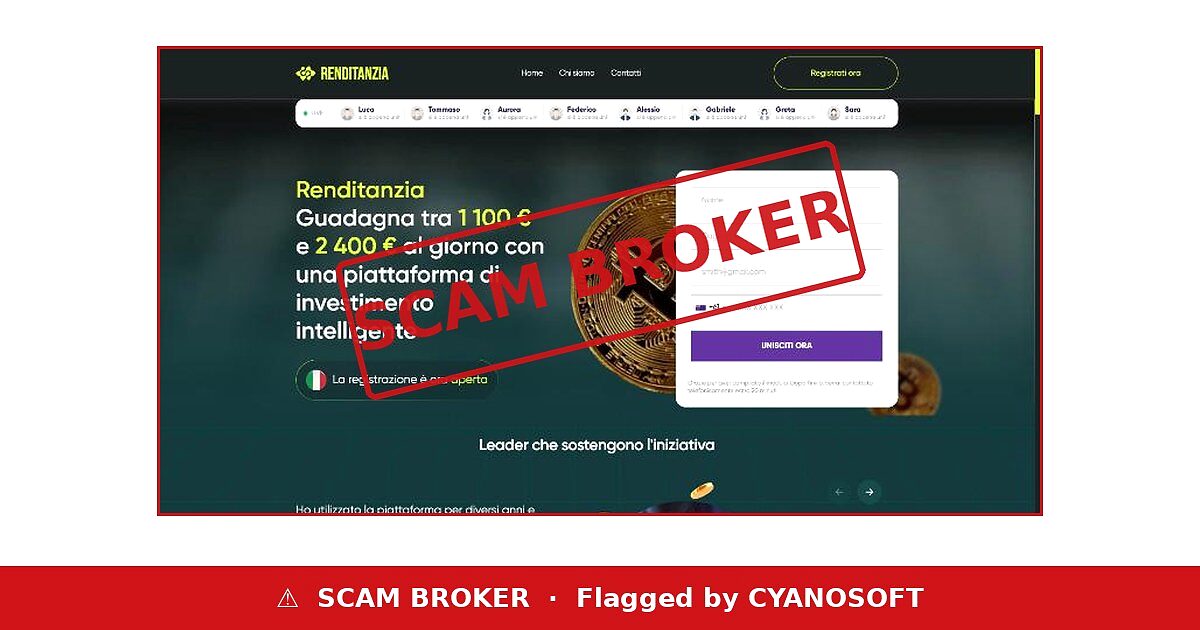
Renditanzia is an Italian language crypto investment platform at renditanziait.com that CONSOB has named as an unauthorised operator. The site was still live when we reviewed it, which makes the warning especially urgent for anyone being pitched right now.
The CONSOB warning
On 5 November 2026 CONSOB listed Renditanzia among operators offering financial services to the Italian public without authorisation. CONSOB has the power to order the blackout of such sites, but blocks take time. Until then the platform can keep taking deposits from visitors who do not realise it is operating illegally.
Live site and fresh domain
The renditanziait.com domain was registered on 29 September 2026, only weeks before the warning. The platform presented itself in Italian with crypto themed returns. A live site on a brand new domain targeting one country with promises of easy crypto gains fits the standard profile of a short window investment scam designed to collect as much as possible before being shut down.
If you are involved
Do not deposit and do not add funds to chase a displayed balance. Capture screenshots of the site, your account and all communications while the platform is still online, as this evidence can disappear once it is blocked. Report it to CONSOB and your bank. Cyanosoft can help you act quickly to preserve evidence and start a recovery case.
⚠ Verified Warning Evidence
- Regulator: CONSOB (Italy) named it unauthorised on 5 November 2026
- Domain renditanziait.com registered 29 September 2026
- Site still live and taking visitors at time of review
- Italian language crypto platform with no valid EU licence
Sources
Rechecked on 17 November 2026
On 17 November 2026 renditanziait.com was still online, calling itself “sito ufficiale della piattaforma in Italia” and promising “Guadagna tra 1 100 € e 2 400 € al giorno”, earn between €1,100 and €2,400 a day. After you fill in the form, it says, “verrai contattato telefonicamente entro 20 minuti”: you will be phoned within 20 minutes. The minimum deposit is €220. The domain was registered on 29 September 2026.
The page shows quotes attributed to an Italian TV journalist and to Italy’s Minister of Economy and Finance, claiming one invested more than two and a half million euros. There is no sign either person endorsed it. Fake endorsements using the names of well-known public figures are a standard feature of these sites, and CONSOB regularly warns about them.
If you already paid
- Stop all further payments, including any “fee”, “tax” or “release charge”.
- Write down every wallet address you sent crypto to and the transaction hash for each transfer.
- If you bought the crypto through an exchange, report the transfers to that exchange’s support and fraud team.
- Report card and bank payments that funded the purchases to your bank as fraud.
- Report the site to the regulator named above and to the police.
- Be wary of anyone who contacts you offering to recover the funds for an upfront fee.
How to check a CONSOB warning yourself
CONSOB, Italy’s market regulator, orders Italian internet providers to block access to unauthorised investment sites and publishes each order. Search the site name on CONSOB’s investor pages and check the registers of authorised intermediaries kept by CONSOB and the Bank of Italy. A firm licensed elsewhere in the EU must appear as passported into Italy. If the site has been blocked, it may reappear on a new address with the same design. Report the site to CONSOB and your bank.
How these schemes usually play out
Sites like this usually follow the same steps. First comes an advert, a social media message or a phone call. Then a small first deposit, often a few hundred dollars or euros. A dashboard soon shows fast profits, and an “account manager” pushes for a bigger deposit. When you try to withdraw, new fees appear: tax, insurance, verification or “unlocking” charges. Paying them never releases the money. At that stage, stop paying, keep every record, and report what happened.
Keep screenshots of the dashboard and your balance, the website address, every email and chat, phone numbers that called you, and every bank, card or crypto payment with dates and amounts. For crypto, keep the wallet addresses and transaction hashes. These records are what your bank, the police and the regulator will ask for first.