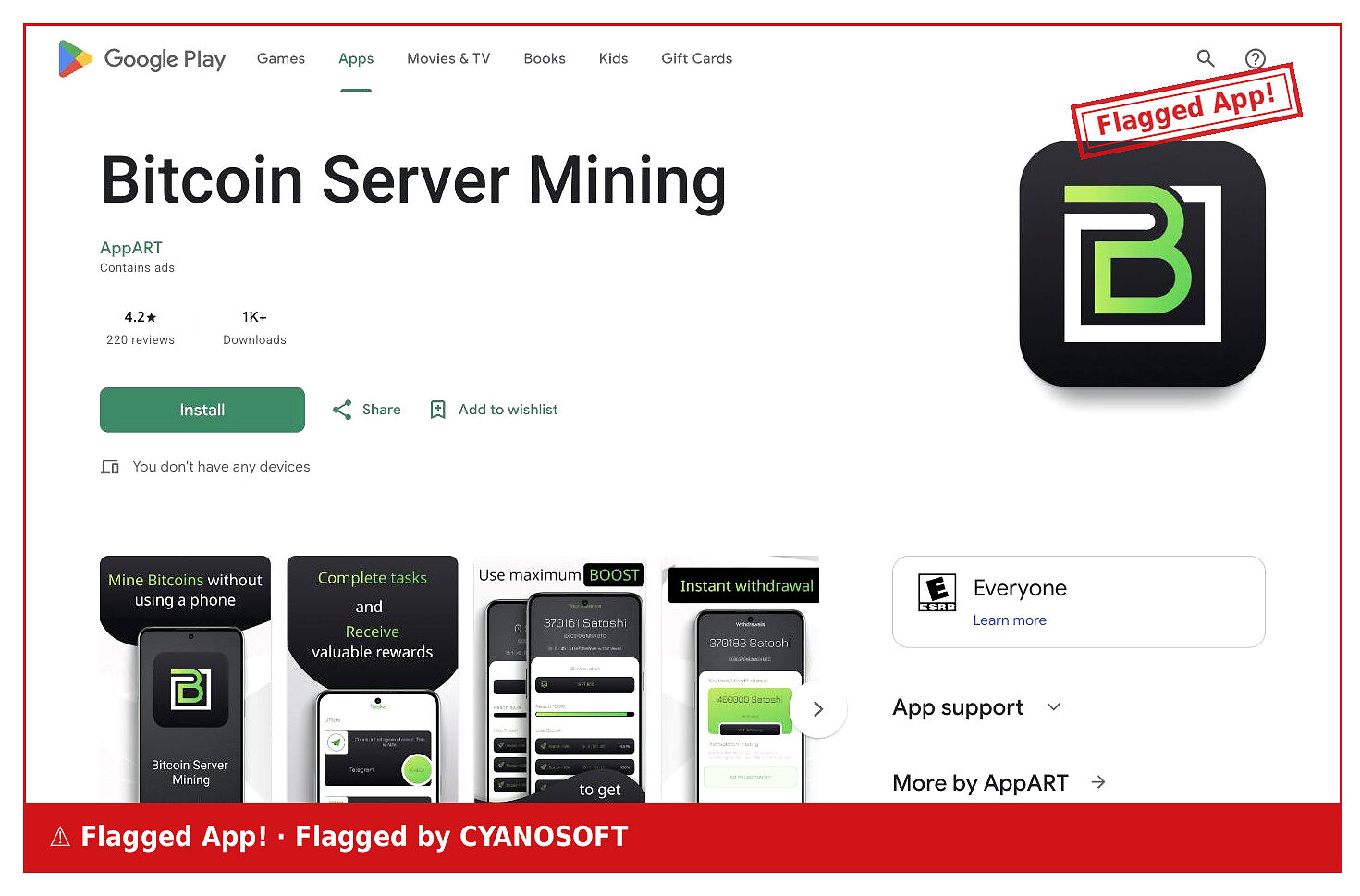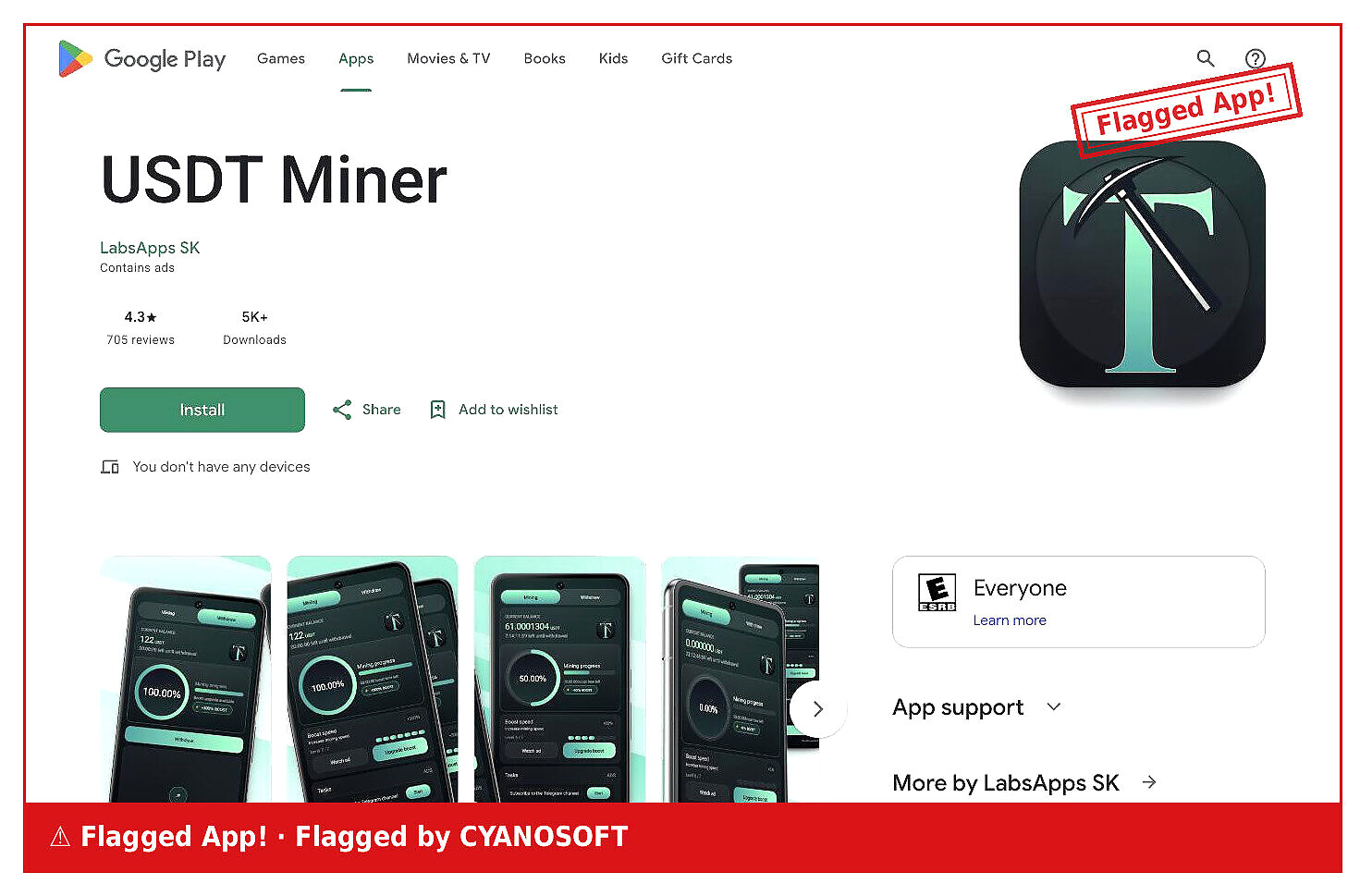
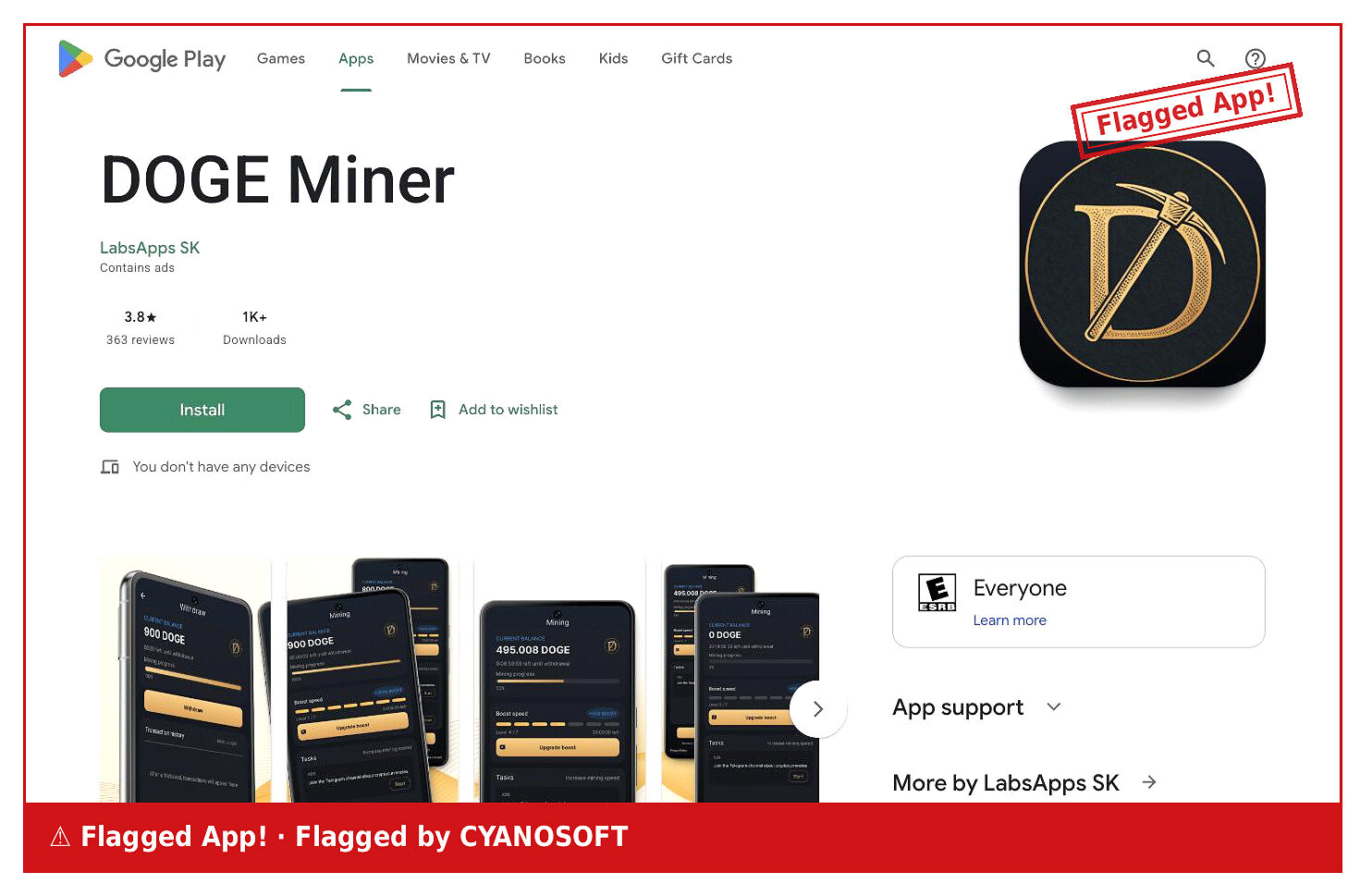
Verdict up front. DOGE Miner uses the same paid-wallet redemption as its sibling app from the same developer. One reviewer reports that the codes fail across all of that developer’s miners — which points at the mechanism rather than at any single app. Do not buy the wallet.
Verified evidence — checked 15 September 2026
- The listing — 1,000+ installs, 363 reviews, rated 3.8. Published by LabsApps SK, an account in the name KHACHATUR SHAHINYAN, contact info@appslabs.am.
- The reviewer names the pattern — A Brouers: “All withdrawals from this app go to a Codes Wallet… codes for withdrawals from all their miners give error messages… invalid code or invalid transactions.”
- It works, then it stops — Marcus H: “First codes were successful, then it errored after… even had the audacity to suggest buying my own codes from another app.”
- Nothing at the end of it — Willie Rice: “2 days and no payout, no support… No Payout for watching all these ads… You will get nothing in the way of actual DOGE, 0, nada, nothing.”
- The sibling app — the same developer publishes USDT Miner (5,000+ installs), which reviewers describe using the identical paid Codes Wallet, at around $20. Cyano Soft covers that app separately.
- What we did not verify — we did not install the app, buy the wallet or attempt a redemption. No regulator warning names this developer.
When a reviewer sees the pattern before you do
Most negative reviews describe one person’s experience with one app. A Brouers’s does something more useful: it reports that the redemption codes fail across every miner this developer publishes.
That shifts the question entirely. A broken payout in a single app might be a bug, a bad release, an overloaded server. The same failure across a developer’s whole catalogue is not a fault in any of them. It is how the catalogue works.
Reviews like that are worth hunting for deliberately. When you are assessing an app, read the reviews of the developer’s other apps too — users who have tried several are the closest thing to an investigator you will find on a store page.
The first code works
Marcus H reports his first codes succeeding and later ones failing. That sequence appears again and again in this category, and it is not accidental.
An operation that never pays anyone collects furious reviews quickly and gets reported. One that pays a little, once, buys something far more valuable than the amount costs: a five-star review saying the app is real, and a user who now believes it and will keep going.
So the encouraging reviews on a listing like this are not evidence against the complaints. They describe the same system observed earlier.
Buy your own codes
The detail worth pausing on is Marcus H’s last line — that he was advised to buy codes from another app when his stopped working.
Follow that through. The payout is a code. The code needs a paid wallet. When the code fails, the proposed remedy is another purchase. At no point does the chain arrive at money moving to the user, and at every point it arrives at money moving from them.
Check the developer, not just the app
On any Play listing, tap the developer name to see everything else that account has published. Individual accounts show a real person’s name, which is how both of these apps became traceable to one operator.
If several near-identical apps share a developer, an email domain or a package prefix, treat them as one thing. It is the same reasoning we used on a warning that named three domains at once.
If you have already paid in
Do not buy the Codes Wallet, and do not buy codes from a third app to rescue a failed redemption. Keep any codes you were issued, the error screens and your receipts — if you paid by card, your bank is the most realistic route. Screenshot your balance and support correspondence before access changes.
Beware the second approach. People who lose money this way are very often contacted again by someone offering to recover it for an upfront fee, sometimes posing as a lawyer, a regulator or the app’s own compliance team. That is a second fraud aimed at the same victim. No legitimate recovery service, and no regulator anywhere, asks you to pay before your money is returned.
Our verdict
A miner whose payout is a code, whose code needs a wallet you must buy, and whose codes — by a reviewer who tried across the developer’s whole range — return invalid.
The most valuable thing on this listing is that one review, because it stopped describing an app and started describing an operation. That is the level to judge at. Our piece on a platform still running after a regulator ordered it to stop makes the same move.