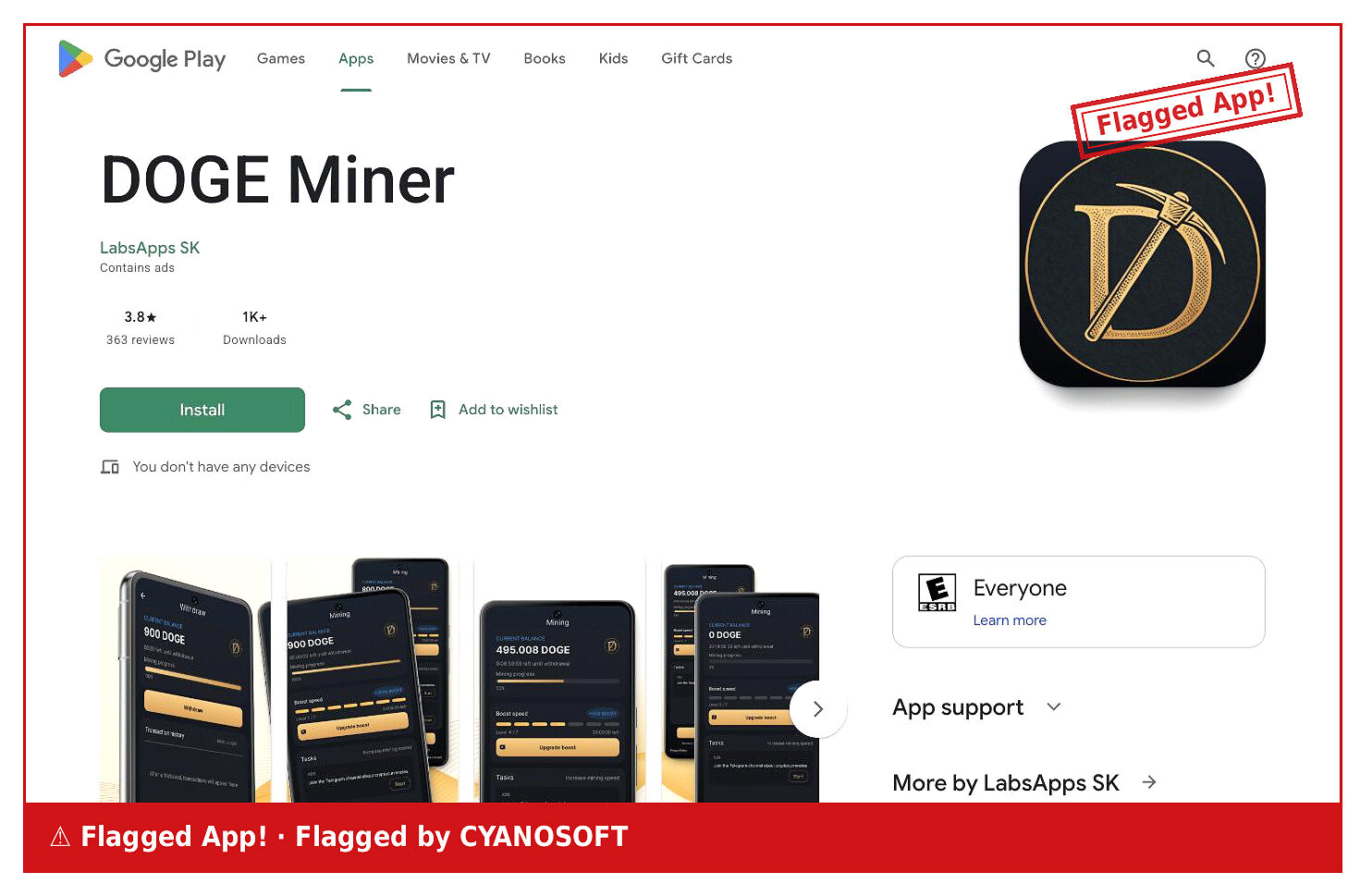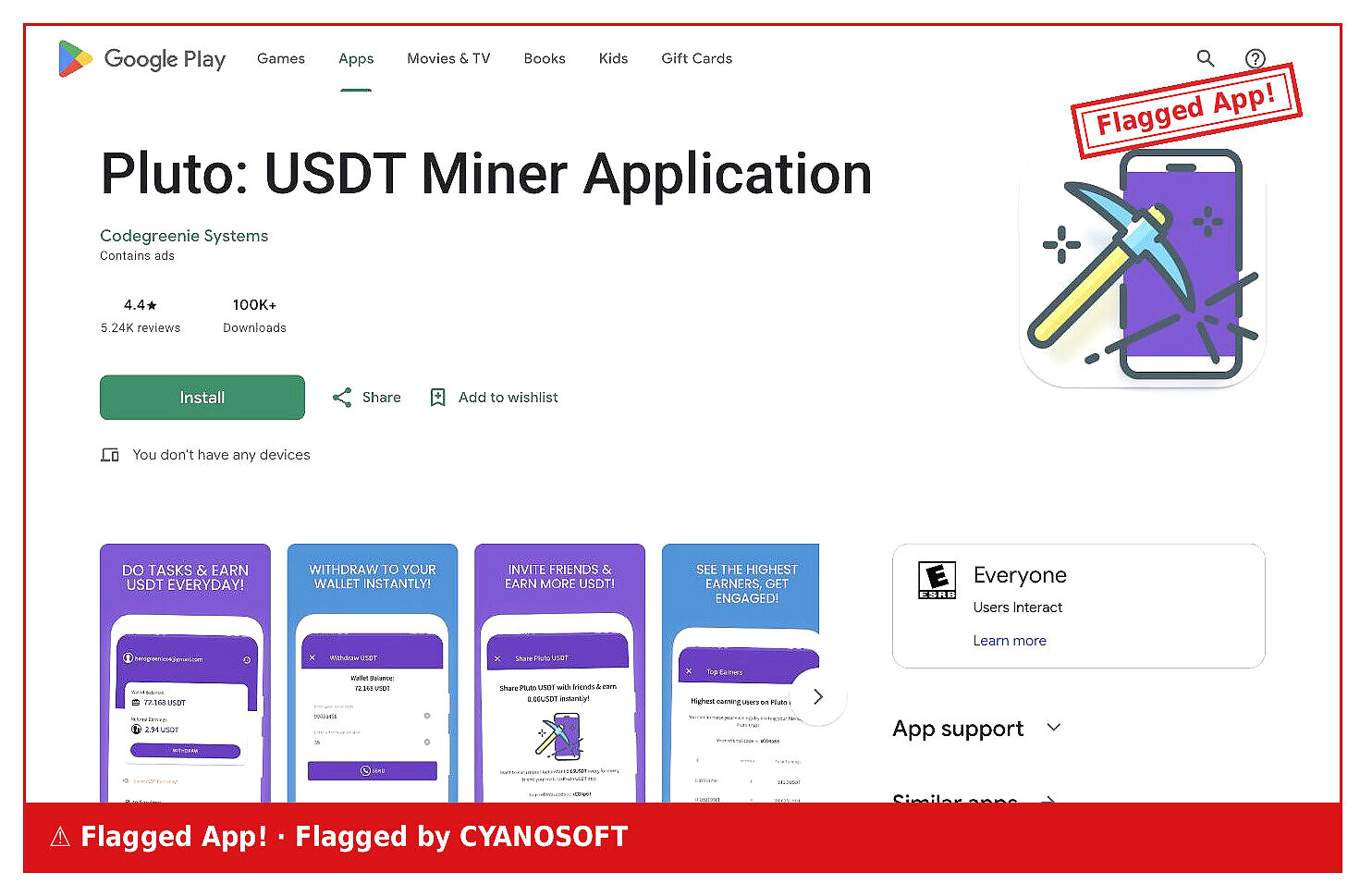
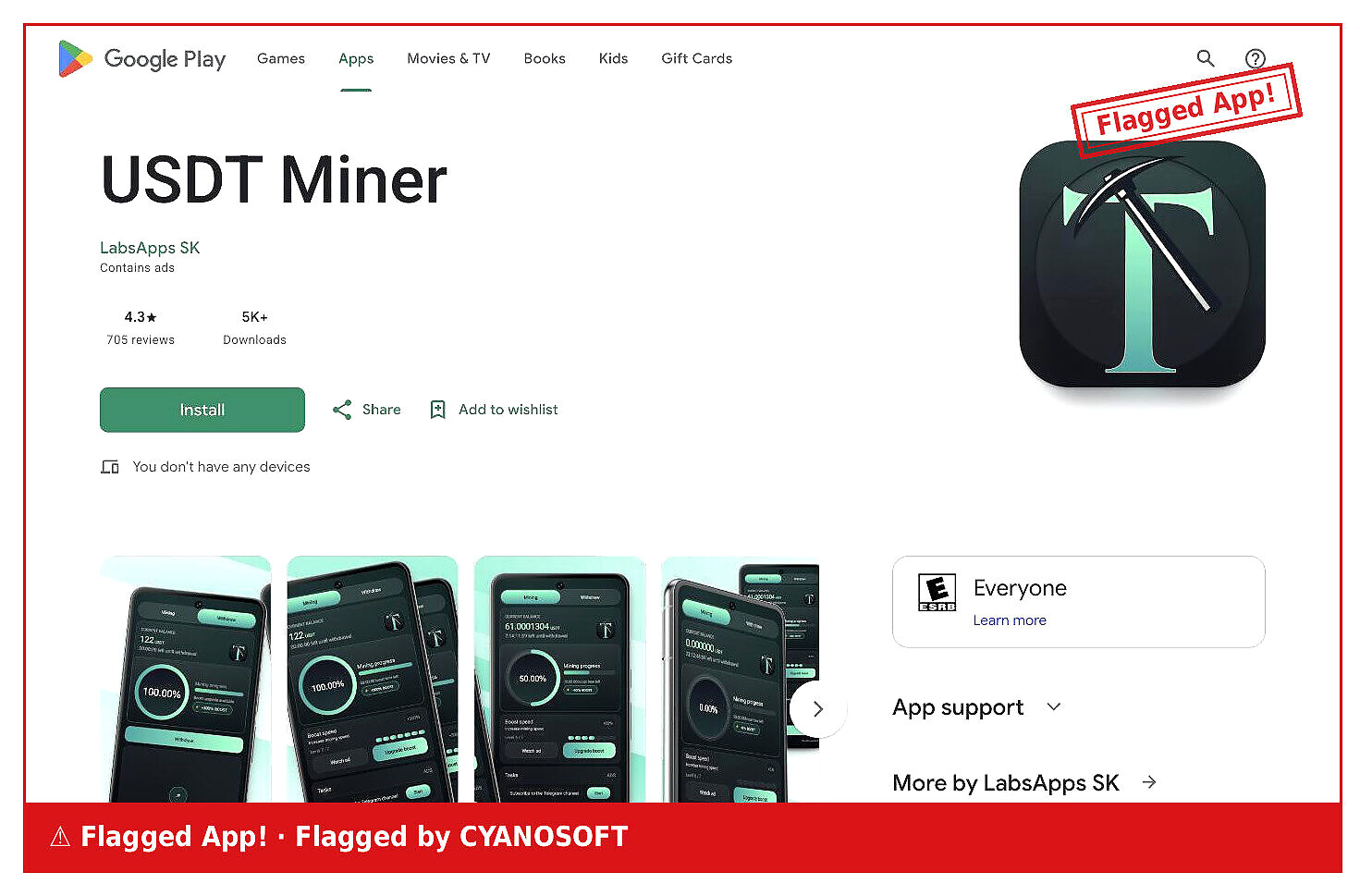
Verdict up front. USDT Miner does not send USDT to a wallet you already own. It issues a code that can only be redeemed through a separate wallet app you must pay for, around $20. Reviewers say the wallet then does not work. Do not buy it.
Verified evidence — checked 15 September 2026
- The listing — 5,000+ installs, 705 reviews, rated 4.3. Published by LabsApps SK, an account in the name Khachatur Shahinyan, contact info@appslabs.am, site appslabs.am.
- One wallet, and you pay for it — Anthony Feller: “The app generates a code that they say can be used in any supported wallet but they only give you 1 choice that you have to pay for… no support. I emailed them… never got a reply.”
- The price, and the result — Hygieng Service: “No customer support… can’t withdraw to any except code wallet which you have to pay almost $20… the wallet isn’t function.”
- The wallet is named — Denver Barnard: “you are given a code and told to download another paid app ‘Codes Wallet’… complaints about them not paying out.”
- Google’s data safety panel — the listing discloses that the app shares device or other IDs with third parties, that data is not encrypted in transit, and that data cannot be deleted. That is the developer’s own declaration to Google.
- What we did not verify — we did not install the app, buy the wallet or attempt a redemption. No regulator warning names this developer.
A code is not a payment
A real cryptocurrency payout is a transfer to an address you choose. It appears on a public blockchain within minutes, and you can verify it yourself without the sender’s cooperation. That verifiability is the whole point of paying in crypto.
This app replaces that with a code. The code is only meaningful inside one wallet, and that wallet must be bought. Nothing is on a public ledger, so there is nothing to check, and the only party who can confirm whether the code was ever valid is the party who issued it.
The refusal to accept your address is the finding
Of everything on this listing, the detail that settles it is that you cannot simply supply your own wallet address.
There is no technical reason for that. Sending USDT to an address is the simplest operation in the system. An app that will not do it, and instead routes you through a purchase, has chosen a mechanism whose defining feature is that it cannot be verified.
If an app will not send to an address of your choosing, it is not paying you.
Read the data safety panel
The most overlooked section of any Play listing is the data safety panel, because developers must complete it and almost nobody opens it.
Here it discloses three things that would each be notable alone: device identifiers shared with third parties, data not encrypted in transit, and no route to deletion. For an app handling payout details that is a poor standard regardless of whether anyone is ever paid.
You can read it on any listing in under a minute, and it is the developer’s own words rather than a reviewer’s.
Pay-to-be-paid, at every scale
The sums here are small — twenty dollars against a balance the app says is yours. The structure is the one we document constantly among firms regulators have named: before your money can be released, one more payment is required.
Whether it is a $20 wallet or a four-figure “tax” on a trading account, the request is identical, and so is the correct response.
If you have already paid in
Do not buy the wallet, and do not spend anything further trying to redeem a code. If you have already bought it, keep the receipt, the codes you were issued and any error screens — with a card purchase your bank is the most realistic route to recovery. Assume the device identifiers and anything you entered have already been shared, and avoid using the app on a network you do not control.
Beware the second approach. People who lose money this way are very often contacted again by someone offering to recover it for an upfront fee, sometimes posing as a lawyer, a regulator or the app’s own compliance team. That is a second fraud aimed at the same victim. No legitimate recovery service, and no regulator anywhere, asks you to pay before your money is returned.
Our verdict
An app that will not send to your own wallet address, that requires a purchase before it will release anything, whose codes reviewers say fail on redemption, and whose own data safety disclosure admits shared identifiers, unencrypted transmission and no deletion.
This is not a payout that is delayed. It is one built so that it cannot be checked. The same developer publishes a second miner using the identical mechanism, which we cover separately — and a cloned broker we examined shows how far the same idea travels.