Verdict up front. This app states plainly that it does no real mining and exists for simulation only. It then sells subscriptions. Reviewers are still asking whether withdrawals work, which tells you the disclosure is not reaching the people paying. Do not subscribe.
Verified evidence — checked 15 September 2026
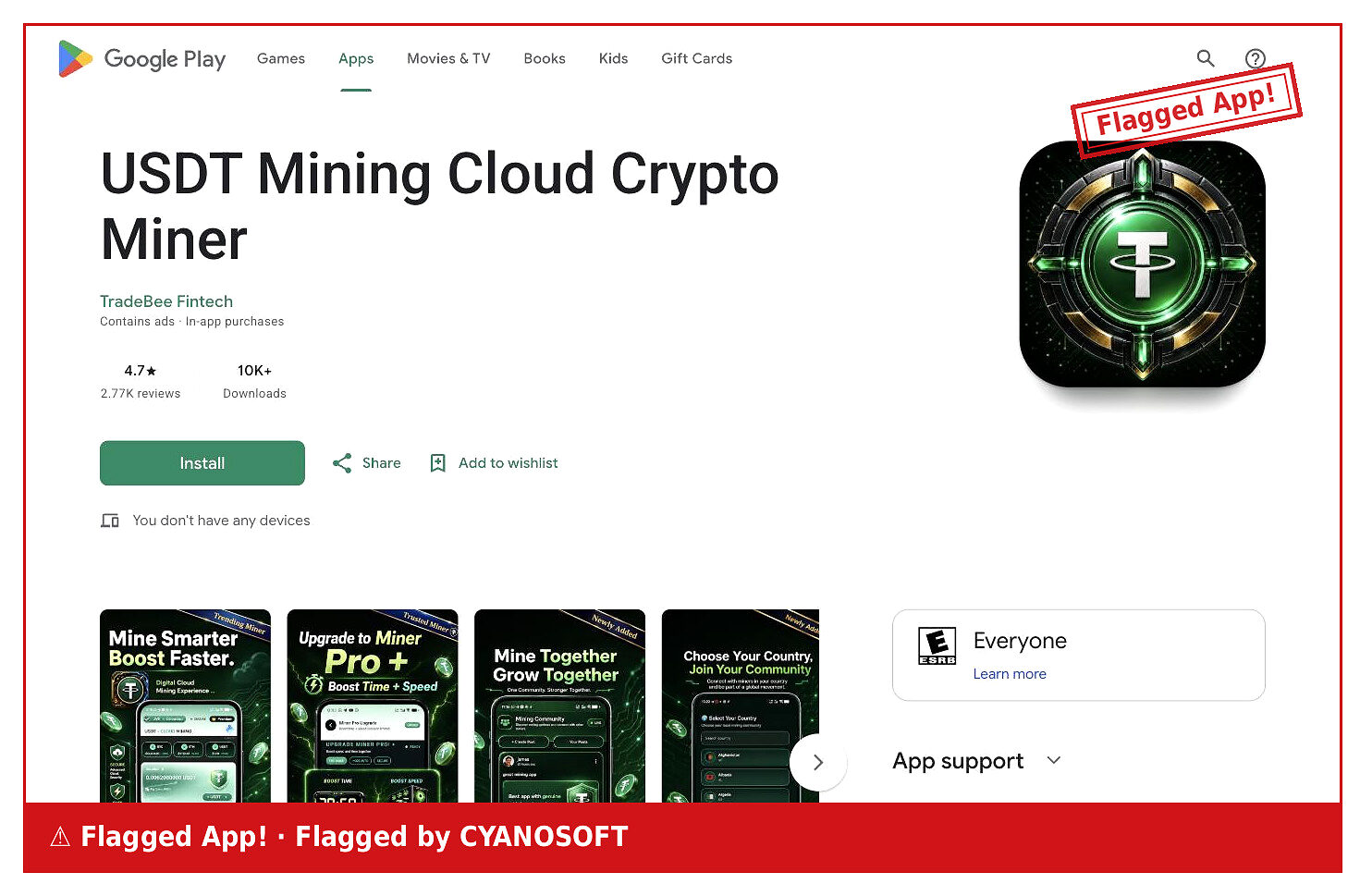
- The listing — 10,000+ installs, about 2,770 reviews, rated 4.7. Published by TradeBee Fintech, with in-app purchases.
- Its own description — “This app is for simulation purposes only. It does not perform real mining or it does not use your phone’s hardware resources for mining.”
- Three identities on one listing — the developer is TradeBee Fintech; the site is tradebeefintech.online; the contact address is drinvest.official@gmail.com; and the privacy policy sits on a third, unrelated domain, usdtold.digital-bundle.in.
- Users are not reading it as a simulation — Jeffrey Hagstrom (29 August 2026) and Ah Min (6 September 2026) both post the identical sentence: “we will see if withdrawals are real and Worthy of purchasing a subscription.” Two accounts, a week apart, word for word.
- What we did not verify — we did not install the app, subscribe or attempt a withdrawal. We have not established who operates the three domains. No regulator warning names this developer.
A disclosed simulation is fine. Selling one is the problem
We have dropped several apps from this series precisely because they were honest — they said they were simulators, took no money, and did what they said.
This one keeps the disclosure and adds a price. That changes the character of it entirely. A free simulation costs a user nothing but time. A paid subscription to a simulation is a purchase, and the thing being purchased is a faster-rising number that the app has already confirmed is not money.
The disclosure protects the operator. It does not refund the subscriber.
The disclosure is not reaching the buyers
The clearest evidence that the small print is not working is on the listing itself.
Two reviewers, writing a week apart, both say they are waiting to see “if withdrawals are real” before deciding whether a subscription is worth it. Those are not the words of people who understand they are using a simulator. They are the words of people weighing up an investment.
A disclosure that every paying user appears to have missed is a legal position rather than an act of communication.
Two identical reviews, a week apart
The other thing about that pair of reviews is that they are the same sentence, from different names, seven days apart.
People do not independently produce identical sentences. Whatever the explanation, it is a reason to treat the 4.7 average and the 2,770 review count as decoration rather than data, and to read only the newest one-star entries.
Three names for one product
A developer name, a website, a contact email and a privacy policy that belong to four different brands is not how a company with one product usually presents itself.
It is, however, exactly how an operator running several products from a shared template presents itself — each listing assembled from whatever assets were nearest. We see the same scattering across cloned broker operations, where the details never quite belong to one another.
Before subscribing to anything, check whether the developer, the website, the support address and the privacy policy agree on who they are. Here they do not.
If you have already paid in
Cancel the subscription through Google Play rather than inside the app, so billing stops regardless of what the app does. Request a refund through Play and keep the receipt; the app’s own “simulation purposes only” line is the strongest thing you can quote in that request, because it is the developer’s own statement that no real earnings exist. Screenshot your balance and the subscription screen first.
Beware the second approach. People who lose money this way are very often contacted again by someone offering to recover it for an upfront fee, sometimes posing as a lawyer, a regulator or the app’s own compliance team. That is a second fraud aimed at the same victim. No legitimate recovery service, and no regulator anywhere, asks you to pay before your money is returned.
Our verdict
An app that tells you in writing it does no real mining, then charges a subscription, while its reviewers openly discuss whether the withdrawals are real.
The honest reading is that the disclosure exists for the store and the subscription exists for the user, and the two are not meant to meet. If you are paying monthly for a balance the developer has already described as simulated, cancel through Play and ask for the money back — and quote their own sentence when you do.
For the same gap between what is written and what is sold, see our piece on a warning covering three domains.